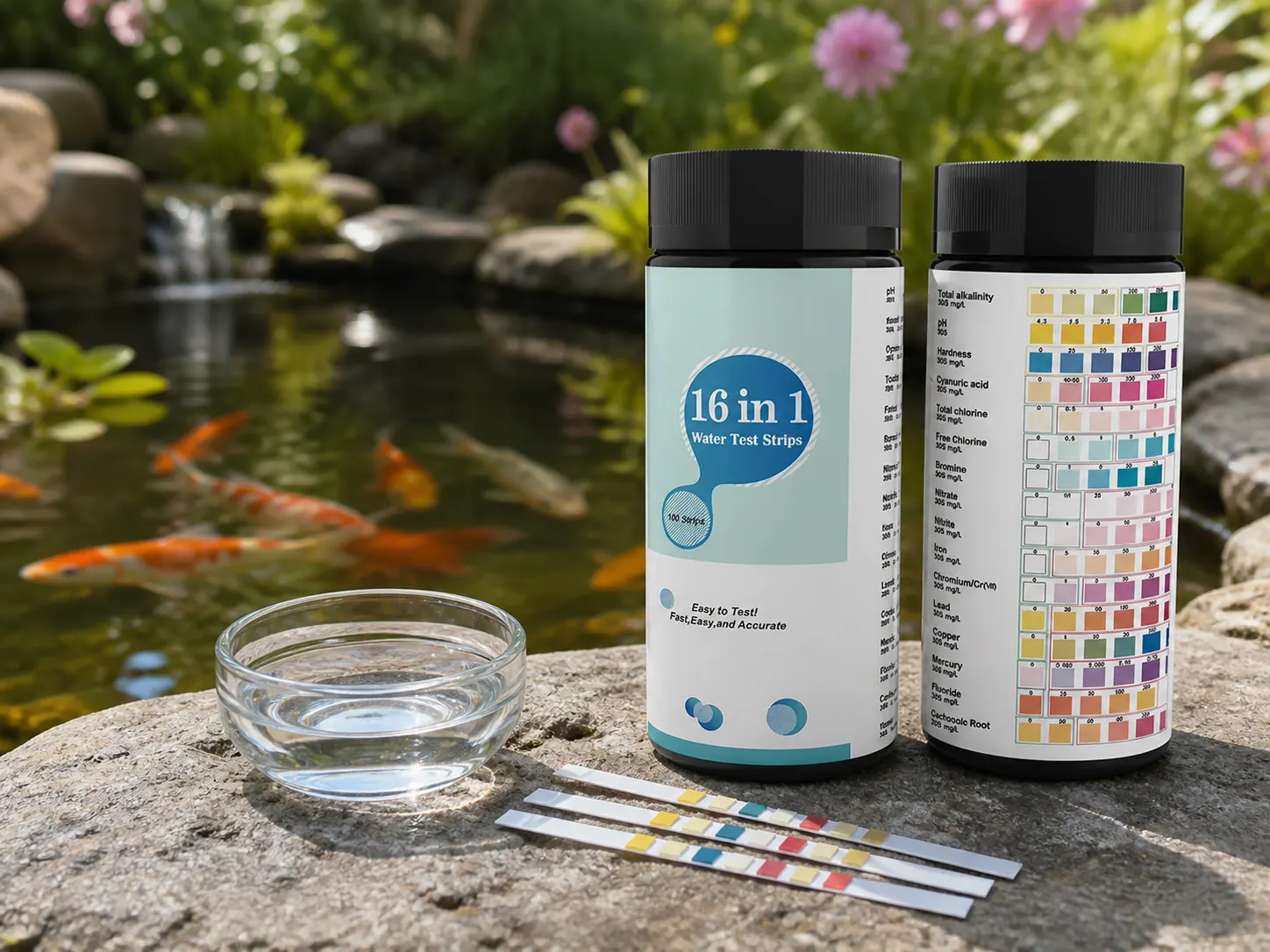
Short answer: Pond water test strips are best understood as a low-friction way to start checking a garden pond, not as a complete answer about fish or water safety. The Aquarfish product page describes 100 16-in-1 strips for pool and fish-pond water checks. It does not publish the individual tests, accuracy or reading conditions. For a UK keeper, the sensible routine is to confirm the chart, take a consistent sample, record the result and compare it with pond observations. When a fish-welfare question needs a named parameter, move to a more specific method.
What pond strips can and cannot tell you
The current Aquarfish page gives three useful buying facts: the product is presented for water quality, the wording says 16-in-1, and the tube contains 100 strips for pool and fish-pond checks. Those facts support repeat screening around a garden pond. They do not disclose the full chart or show that the strips replace a parameter-specific or laboratory test.
OATA recommends regular checking as part of pond fish care and identifies ammonia and nitrite as important before adding fish. Because the Aquarfish page does not list individual parameters, confirm those or any other required checks on the package rather than inferring them from the product name.
| Question | Use the listing for | Do not infer |
|---|---|---|
| How many tests? | 100 strips per tube | A required testing frequency |
| Where is it aimed? | Pool and fish-pond water | Suitability for every pond species |
| What does 16-in-1 mean? | A multi-check product label | The full parameter list |
| How reliable is it? | No performance value is published | Accuracy, range or laboratory equivalence |
Create a simple pond testing habit
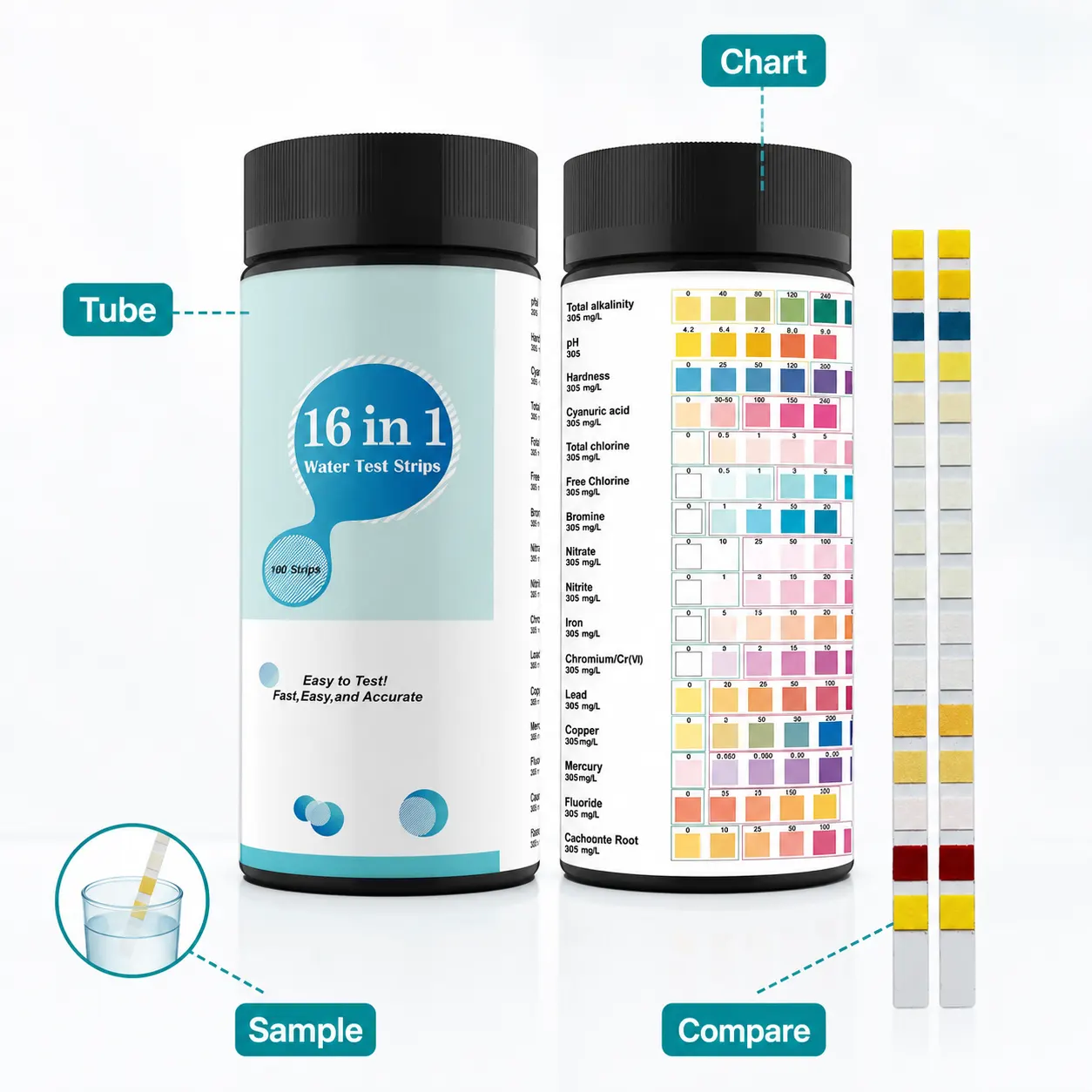
A repeatable habit starts with the same question and the same kind of note. Record why you tested, where the sample came from, what the pond looked like, whether maintenance or feeding changed, and what the chart showed. If the colour is between blocks, keep that uncertainty in the record instead of forcing a precise number.
When the reading is unexpected, pause before changing several variables. A second sample, a parameter-specific kit or advice from an aquatic retailer may be more useful than repeated guesses. The product page does not state a reading window or an accuracy tolerance, so careful handling cannot be replaced by confidence in the number.
- Check the chart for the exact question you are trying to answer.
- Take a clean sample and follow the product instructions for dipping and timing.
- Read the colours in consistent light and note any ambiguous result.
- Compare the result with recent pond notes, fish behaviour and maintenance.
- Choose monitoring, retesting, a specific test or specialist advice as the next step.
Use pond observations without overdiagnosing
Clear water does not prove that every relevant condition is suitable, and a worrying fish does not prove that one strip parameter is the cause. OATA's care material supports testing as part of pond management, but the Aquarfish listing makes no fish-health or treatment claim.
Use the strip to make the next question clearer. If a fish is unwell, combine the observed signs with a suitable water test and ask an aquatic specialist. Do not describe a normal-looking strip as a guarantee that fish are healthy, and do not use it as a substitute for urgent help when the pond is deteriorating.
Limits and checks before buying
Manufacturer does not specify the individual parameters, accuracy, range, reading time, storage, calibration, certification or compatibility with pond treatments. These are not small editorial gaps if your purchase depends on a precise decision. Check the packaging or request the missing information before relying on the strips.
Choose this format when you want a pond-oriented tube with 100 repeat checks and you accept a screening role. Choose another method when you need a named parameter, a documented performance specification, a fish-health conclusion or a drinking-water result.
Related guides and product details
Use pond strips to start a documented checking habit, then move to a named test or specialist advice when the decision needs stronger evidence. Read Fish Pond Test Strips UK: What to Check First for related guidance. Read Koi Pond Water Test Kit: Match the Checks to the Evidence for related guidance. Review the documented specification on the 16-in-1 Pool and Fish Pond Water Quality Test Strips, 100 Strips product page before ordering.
Sources and safety context
- Supports the 100-strip quantity, 16-in-1 wording and pool and fish-pond water-check positioning. Current Aquarfish product page.
- Supports regular pond water checks and cautious fish-care context; it does not certify this strip product. How to look after pond fish.